Product study · 2026
Nomvy
How we designed and built an AI calorie tracker that lists the oil, ghee and dressings a photo can’t see, and lets people fix an estimate with one sentence.
- Product strategy
- Product design
- Mobile app development
- AI engineering
Counting what the photo can’t see.
Photo calorie apps usually return one confident number. The parts most likely to be wrong are hidden inside it: the oil a curry was cooked in, the ghee on a roti, the sugar in the chai, and portions measured in katoris and plates rather than grams. For South Asian and other home cooking, that hidden fat can be a large share of the meal. Nomvy is our own product, an AI calorie tracker for Android and iPhone built with Expo and React Native on a Node, MongoDB and Redis API. We built it around the places photo estimates go wrong.
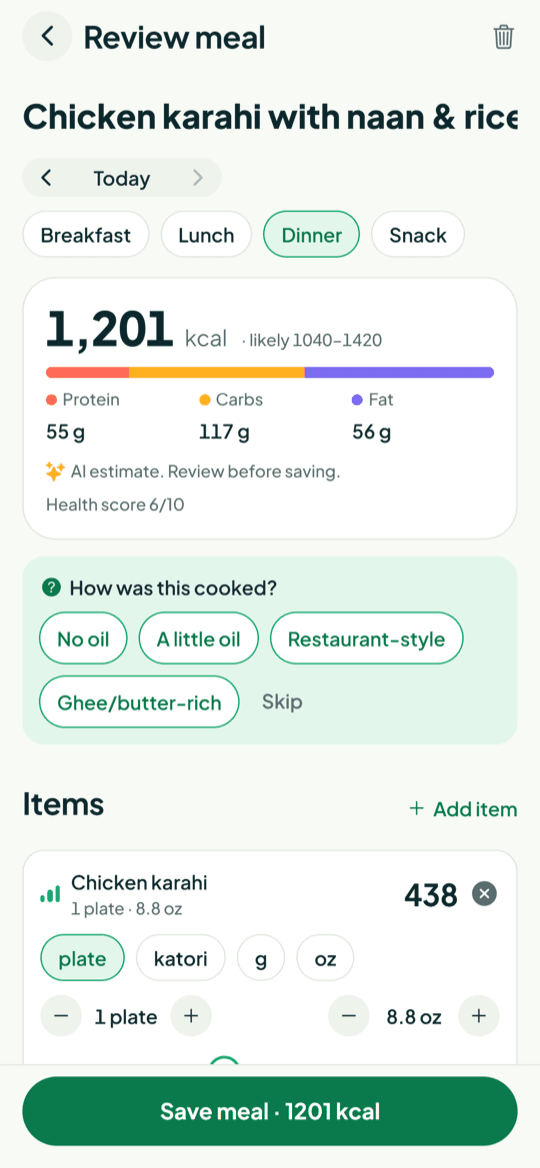
Give people an estimate they can check and correct: every item editable, hidden fats on their own lines, an honest range instead of one exact-looking number, and corrections that take one sentence rather than ten taps.
How we approached it.
- 01
Make hidden calories visible
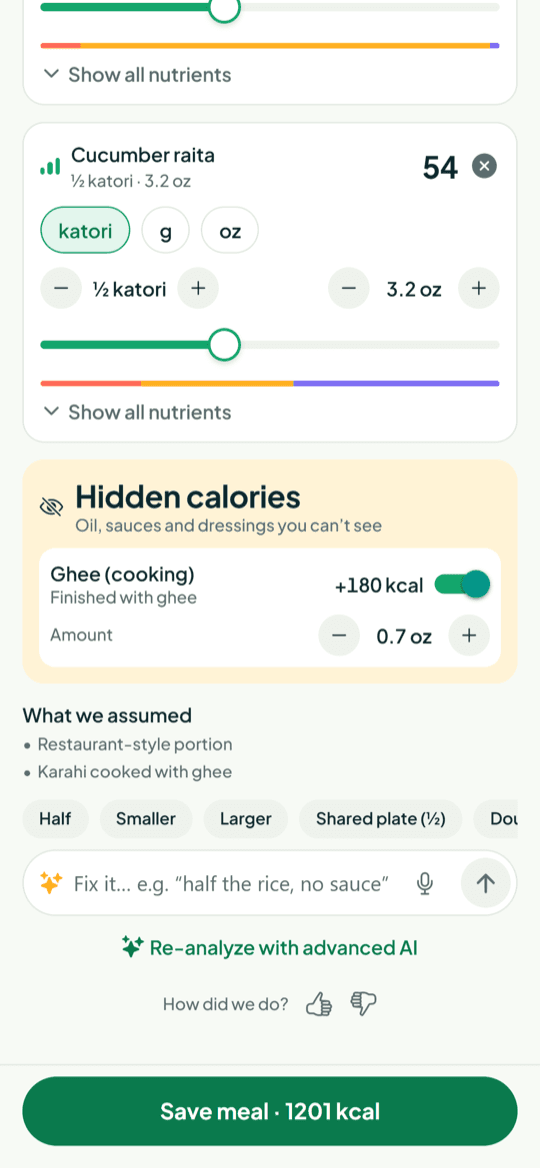
Cooking oil, ghee, butter, dressings and sugar in drinks come back as separate lines, each with the assumption behind it written out, such as “1 tbsp oil used in cooking”. Each line can be switched off or resized on its own, and the total and range move with it. When the cooking method is unclear, the app asks one tap-to-answer question and applies the answer on the phone, with no extra AI call.
- 02
Let data correct the model
The model is good at judging how much is on the plate, and less reliable about what a gram of a dish contains. So we keep its grams and replace its per-gram values with database figures when a name matches closely enough: the user’s own foods first, then our curated Regional Pack, then USDA FoodData Central. A density check rejects matches that share words but not recipes.
- 03
Correct with a sentence, apply by id
“Half the rice, no sauce, it was 2 rotis” goes to the model, which returns small operations keyed by item id, not a rewritten meal. Our server applies them and ignores unknown ids, so items the user didn’t mention can’t change. Common phrases such as “no oil” or “double it” are handled by rules, with no model call at all.
- 04
Learn only from real corrections
Smart Memory learns a user’s portion bias per food, but only from edits measured against the server’s own record of the original estimate. It needs at least two corrections, is clamped between half and double, never touches hidden fat lines, and is always labelled on the item so it can be undone, switched off or reset.
The operating areas brought together.
- Photo, voice and text logging
- Photos are resized to a 1,024 px long edge and re-encoded on the phone, which drops location data, and the server strips metadata again before any model sees them. Voice is transcribed by the phone’s own speech recognition, so the server receives text, never audio. Barcode, search and quick add work without using AI at all.
- A review screen built for editing
- Every result is a draft. Items have a three-level confidence bar rather than a percentage, unit pickers with household units such as katori and roti, gram steppers, swipe to delete with Undo, and “Reset to AI estimate”. The draft survives navigation, and a failed save keeps every edit.
- Structured, validated AI output
- Every model call is defined by a zod schema that is sent as the output format and then checked again on our server. Numbers are clamped, calories are repaired from macros when they disagree by more than 30%, and an invalid or truncated answer is retried once before the request moves on.
- Regional food data
- A curated Regional Pack of 334 entries, 315 dishes and 19 basic ingredients, with South Asian, Middle Eastern, East Asian, Latin, African and Western home cooking, household serving sizes and transliterated aliases. It sits alongside USDA FoodData Central and Open Food Facts, with server-side caching.
- Model routing and cost control
- Scans start on a small, fast model and escalate to a larger one only for low confidence or busy plates. Prompts are cached, identical requests can be served from a response cache, and a provider chain falls back to other AI providers using the same prompts and schemas. Every call’s tokens, latency and cost are recorded, with daily budget alerts and a hard spend stop.
- Plans and privacy
- The free plan includes 3 AI logs a day, enforced on the server and given back when a photo isn’t food or a call fails. Pro runs through RevenueCat. No ads, no name or email sent to AI providers, scan records deleted after 30 days, and data export and full account deletion in the app.
How the product holds together.
The hardest problem was counting cooking fat once. The model lists hidden oil and ghee separately, but when we then ground a dish in a database whose home-preparation values already include the fat it was cooked in, the same oil can appear twice. The pipeline records the model’s fat for each item before grounding, measures the extra fat grounding added, and subtracts it from the generic oil, ghee and butter lines, removing any that fall below 2 g and telling the user why. It works because we treat model output as untrusted input. The model estimates, and deterministic code on our server checks, grounds, reconciles and totals, so every number on the review screen can be traced and corrected.

Let’s build yours next.
Nomvy is live on Google Play, with the iPhone version to follow on the App Store, in 12 languages. We did all of it: product definition, interface design, the mobile app, the API, the AI pipeline, pricing and store listings, and we run it ourselves. It is the same approach we bring to client work.