Product study · 2026
Darezo
How we built a party-game app that plays offline on one phone, runs online rooms for up to 12 players without accounts, and keeps a growing card bank safe to serve.
- Product design
- iOS and Android engineering
- Realtime backend
- Content systems

One phone, a full room, patchy Wi-Fi.
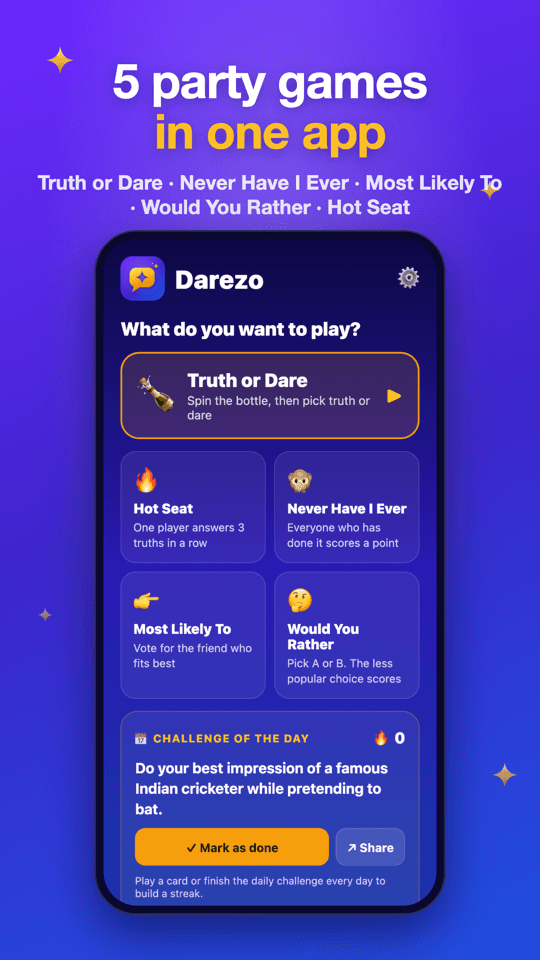
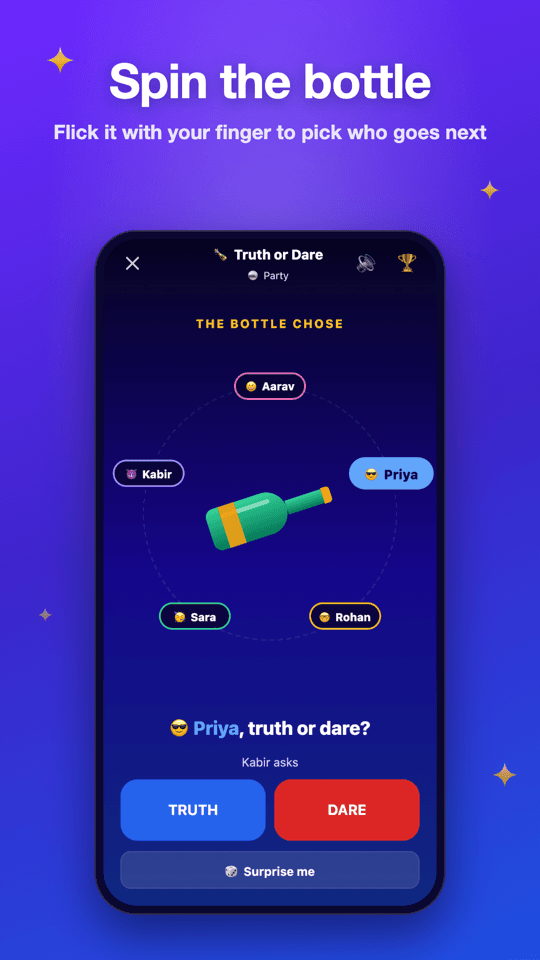
Party games are played by a group passing one phone around, often on patchy Wi-Fi, sometimes with friends joining from a video call, and with a mix of ages and languages in the room. Darezo is our party-game app: Truth or Dare with a bottle you flick, Hot Seat, Never Have I Ever, Most Likely To and Would You Rather. It needs no account, works offline, and plays in English, Hindi or Hinglish.
A game that starts in seconds without sign-up, suits the group it is played with, works fully offline, and lets friends play together from their own phones without the server ever storing who they are.
How we approached it.
- 01
One engine for every way of playing
The whole game is a serialisable state changed only by a pure reducer. It contains no randomness and no I/O: callers draw cards and pick spin targets and pass them in. The same engine drives a game on one phone, a saved game resumed later and an online room.
- 02
The host’s phone runs the game
In an online room the server does not play the game. It authenticates players, relays the host’s state to everyone, and forwards guests’ small, typed actions to the host, whose app decides whether that player may make that move. The server stays simple and the rules live in one place.
- 03
Cards matched to the group
Players choose who they are playing with: Friends, Couples, Family, Party or Office. Family and Office never go above Mild. Spicy cards appear only after confirming every player is 18 or over, the confirmation expires after a few hours, and ads never appear in a Spicy game.
- 04
Online is optional
Every game works with no network. Online rooms, the daily challenge, themed packs and new cards come from a small Node service, and when it is unreachable, switched off in Settings or disabled with a server-side kill switch, those features are simply hidden.
The operating areas brought together.
- Online rooms
- Room codes skip look-alike characters so they can be read out on a call. Rooms hold up to 12 players and 32 KB of state, live only in memory, expire after 30 minutes idle or six hours, and pass to another player if the host drops for 45 seconds.
- Reconnection on real networks
- The app retries with exponential backoff and jitter, detects sockets that died without closing, reconnects the moment the phone switches from Wi-Fi to mobile data, and queues a guest’s moves while the host is away so they are sent, or the player is told, rather than lost.
- A growing card bank
- When players near the end of a deck, the server writes a fresh batch in the background with OpenAI, using only enums and recent card text, never anything a player typed. Phones download new cards by an id cursor and keep them on the device, in per-deck files with a size cap, for offline play.
- Moderation in layers
- Every generated card passes OpenAI moderation, which fails closed, then format rules per card type and language, shared content rules and a second reviewer pass. New Spicy cards wait for human approval, and a card reported from five different networks within a week stops being served.
- Abuse controls without accounts
- Daily limits key on a salted hash of the IP address that changes every day. IPv6 is grouped by /64, with deliberately loose /48 limits because Indian carriers share them across thousands of subscribers. Player names are normalised so look-alike letters cannot slip a slur or a duplicate past the filter.
- Privacy and consent
- Usage stats and crash reports start off in the EEA, the UK and Switzerland, ads are never personalised and never shown during a game, and the website’s privacy and terms text is generated from the app’s own legal text by a script, so the two always say the same thing.
How the product holds together.
The hard part was keeping online rooms fair and stable on one small Node process with no accounts. Joining gives a random 256-bit seat token, of which the server stores only a SHA-256 hash; the token travels in the first WebSocket message, never in a URL, and rotates on every welcome, while the previous one stays valid once so a welcome lost in a dropped connection does not lock a player out. The server pings every socket every 30 seconds to find half-open connections, cuts off any reader with more than 512 KB of unsent data, and gives each socket a token bucket. When the host’s phone is briefly away, a guest’s move is handed back to their app to resend, instead of vanishing. All of this is held in memory by design, which is also its limit: the service must run as exactly one instance, and scaling past it would need a shared room directory that we have not built.

Let’s build yours next.
Darezo is published by QuantumPlug on Google Play. We designed and run all of it: the game engine, the card content and its rules, the backend, the store listings and the moderation.